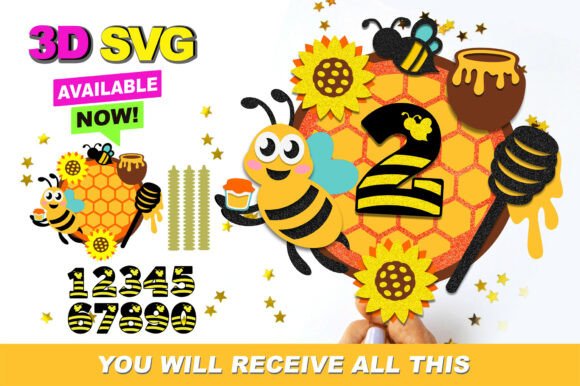
Reviewing the Honey Bee Cake Topper 3D SVG for Stitchers
As a designer who has spent countless hours hooping fabric and watching needles dance, I approach every new digital asset with a mix of curiosity and caution. We are often bombarded with files that look stunning on a screen but fail to translate into thread. When I first opened the Honey Bee Cake Topper 3D SVG, my initial reaction was not just about the visual appeal, but about its structural integrity for physical creation. While the product description highlights its compatibility with Silhouette Studio and Cricut Design Space, my focus was strictly on how this graphic would perform as a machine embroidery design or a layered craft element in a real-world scenario.
First Impressions: Mood and Visual Personality
The immediate mood this design evokes is warm, whimsical, and artisanal. The "3D" aspect suggests depth, which is crucial for standing out in a crowded market of flat, generic graphics. For embroidery designers, this implies a need for careful layering or strategic stitch types to mimic that dimensional look. The shape is organic, avoiding the rigid geometry that often plagues digital graphics. It feels like it belongs in a spring collection, perhaps paired with floral motifs or rustic typography.
What strikes me most is the balance between detail and simplicity. A design that is too intricate can become a nightmare of thread breaks and bird nests, while one that is too simple lacks value. This Honey Bee Cake Topper 3D SVG seems to hit a sweet spot, offering enough character to be recognizable without demanding an unreasonable amount of machine time. It creates a visual personality that says "handmade with care," which is exactly what customers look for in a personalized gift.
Real-World Application: From Screen to Stitch
To truly evaluate this asset, I imagined a specific project: a custom embroidered tote bag for a local farmer’s market vendor. The client wanted something cheerful and brand-consistent. Using this bee motif, I considered how it would interact with the fabric texture of a heavy canvas tote. The bold lines of the design would hold up well against the weave, ensuring the image remains clear even from a distance.
Beyond totes, I see this design working beautifully on sweatshirt embroidery. The cozy nature of a bee theme pairs perfectly with fleece or cotton blends. However, when moving to custom apparel like t-shirts, one must be mindful of the stitch density. If this SVG is converted into a dense fill stitch without proper underlay, it could cause puckering on thinner fabrics. For baby embroidery projects, such as onesies or burp cloths, the design would need to be scaled down significantly, ensuring no small, loose threads pose a safety hazard.
For those running a craft business, versatility is key. This design could easily be adapted into an embroidered patch if stitched on felt or twill with a satin stitch border. Patches are high-margin items for Etsy sellers and small shop owners because they are easy to ship and highly collectible. The 3D effect mentioned in the title could be achieved through layered applique techniques, where different colored fabrics are stacked to create physical depth before any stitching begins.
Navigating Technical Challenges
While the aesthetic is promising, there are areas where caution is required. The term "3D" in digital design assets can sometimes be misleading. In embroidery, true 3D usually refers to foam-backed satin stitches, often used in caps. If you plan to use this on curved surfaces like hats, you must ensure the design is not too wide, or it will distort around the crown. Additionally, hoop size limitations come into play. If the design includes tiny details or text, these may get lost if the hoop is too large relative to the design scale, or if the machine’s resolution cannot handle micro-stitches.
Dark fabrics present another challenge. If you are stitching this bee on a navy or black garment, you will need high-contrast thread colors. A yellow body with black outlines works well, but if the design relies on subtle shading, it may vanish into the background. Always test your embroidery file on scrap fabric of the same weight and color as your final product. This step is non-negotiable for maintaining professionalism and avoiding wasted materials.
Furthermore, consider the washability of the finished product. Items like kitchen towels or aprons undergo frequent laundering. Dense stitch areas can become stiff over time. Using a high-quality stabilizer is essential to prevent the design from pulling away from the fabric after multiple washes. For items that need to remain soft, such as baby blankets, consider using a lighter fill stitch or reducing the density in the software if possible.
Enhancing Brand Value and Customer Trust
From a business perspective, the quality of your design directly impacts customer trust. A crisp, well-digitized image signals professionalism. When a buyer receives a handmade product with clean edges and consistent stitching, they are more likely to leave positive reviews and return for future purchases. The Honey Bee Cake Topper 3D SVG, when executed correctly, adds a layer of perceived value. It transforms a basic item into a boutique-worthy piece.
For digital product sellers, this graphic can also serve as a base for printable mockups. Showing potential buyers how the design looks on a real garment helps bridge the gap between digital expectation and physical reality. It aids in buyer engagement by providing a tangible sense of the final result. Whether you are creating holiday embroidery gifts or everyday wear, the consistency of your brand relies on the reliability of your design choices.
Practical Notes for the Embroidery Designer
Before committing to a full production run, here are my recommended steps for working with this type of graphic:
- Test on Scrap Fabric: Always stitch a sample on the exact material you intend to use. Check for puckering, thread breaks, and registration issues.
- Check Thread Contrast: Ensure your chosen thread colors stand out against the fabric. Use a black-and-white mockup to verify value contrast if you are unsure.
- Review Stitch Density: If converting this SVG to an embroidery format, adjust the density to suit the fabric weight. Heavy denim can handle more stitches than lightweight cotton.
- Confirm Hoop Size: Make sure the design fits comfortably within your hoop, leaving enough margin for the frame to grip the fabric securely.
- Inspect Small Details: Zoom in on the digital file. Are there tiny isolated stitches that might pull out? Simplify if necessary.
- Verify Licensing: Since this is a digital download, confirm whether the license allows for commercial use. Can you sell items made with this design? Can you resell the digital file itself? Clarifying this protects your small shop product line from legal issues.
In conclusion, the Honey Bee Cake Topper 3D SVG offers a charming and versatile option for creators in the Crafts category. Its success lies not just in the download, but in the thoughtful application of embroidery principles. By considering fabric, stabilizer, and stitch technique, you can turn this digital graphic into a standout physical product that delights customers and strengthens your brand.